I think Radley Balko is onto a great strategy to promote liberty. It's basically the same strategy non-libertarians (statists, alarmists, public healthists, public safetyists, etc.) have been using for years. The strategy? Focus on the personal victims of whatever evil you're trying to expose. Think about it...for smoking ban advocates, it's stories about the poor single-mom waitress who has lung cancer despite never smoking a day in her life after working at a restaurant (where smoking is allowed) for 30 years. For the MADD crowd, nothing's more effective than the infamous "Happy Birthday" commercials where a home video of a child's birthday party is shown while a narrator informs viewers that the child was killed by a drunk driver. For food safety alarmists, it's not the fact that 15 out of 300 million people got sick from eating bad spinach, it's that the old man is in critical condition at a local hospital after eating a salad.
Libertarians and free market advocates know they're right in the grand scheme of things. It's not even close. Look at things like global standards of living, then look at levels of economic, social, and press freedom. On the macro level, it's clear that greater liberty equals a better society for all. On the macro level, the few people who actually care enough to objectively consider the macro-level generally accept this idea.
But on the micro level, where most of the people (most of the voters!!) make their decisions, the non-libertarians dominate. When was the last time you saw a local (or even national) news story that focused on the abuse of power by government and/or how government hurts people's lives. Rarely. And if there is such a story, it's usually couched in terms that make the government's co-conspirators (such as a money-hungry corporation) look worse than the government. What's far more likely is a story about how some business or landlord is ripping people off, how someone died because of "gun violence," or some victim-laden story about the "digital divide" or the growing gap between rich and poor. And almost inevitably the stated or implied solution to such problems is more government action.
Anyway, back to the lecture at hand. "If it bleeds, it leads." That's the de facto axiom of news broadcasts. Why? Because people sympathize with personal stories. It doesn't even really matter what the story is; if there's a personal story with a likable person as a victim, it's perfect for the news.
And I think that libertarians are finally realizing this. Radley Balko is leading the charge at using personal stories to illustrate how government policies and government corruption can ruin the life of a real, actual person with a face and a name. Finally libertarians are understanding that what sells are personal stories on the micro level. You can talk all you want about how increased economic liberty will lead to a better society for all, but that point gets lost on most of the audience. What really gets people are real-world examples of individual victims.

Saturday, December 23, 2006


Friday, December 1, 2006
Design For Not Needing To Be Fixed
 I finally fixed the door knob for the door going between the garage and my house (for the last couple of months I had just taped the latching mechanism opened so that I wouldn't have to deal with it), and I discovered that the door knob has a really obvious design flaw. But first some background.
Background
A couple of months ago, I attempted to open the door going to the garage from inside the house. To my surprise, the knob turned, but the door didn't open. I kept turning the knob, and nothing happened...I quickly deduced that the knob wasn't mechanically coupled to the latching mechanism, so turning the knob would do no good. Since the only other way into the garage was through the garage door openers inside the cars that were parked inside the garage, the only way I could get into the garage would be to somehow open the door. Luckily, after a couple of attempts, I was able to pry the latch open by wedging a butter knife in-between the latch and the slot in the door frame into which the latch moves, and I got the door open. Since I was in a hurry, I simply put a piece of tape over the latch to prevent it from going back into the slot when the door closed.
Later, when I removed the entire door knob assembly, I figured out that the way the knob was coupled to the latch was with a simple square (square in cross-section) bar. As the diagram below shows, the Square Slot (in which the Square Bar resides) in the Internal Door Knob has an extra little feature that the Square Bar press-fits into. The square bar travels through the Door, through the Latching Mechanism, and into the External Door Knob. Turn either knob, and the square bar to which the knob is rigidly fixed turns the latching mechanism and just like that, the door unlatches.
 Figure 1 - How it's supposed to work
After looking at all the parts of the door knob assembly, I realized that to fix it, I'd simply have to re-rigidly-fix the square bar to one of the door knobs. This was easy enough, and in just a couple of minutes the door knob was back on the door, fully functional.
The design flaw
So what's the big deal? Well, this whole charade could easily have been avoided if the door knob were better designed. The following diagram shows what the door knob system looked like when it was broken.
 Figure 2 - How it broke
The solution
The solution to all of this madness would simply be to make the Square Bar longer. In fact, it should be almost as long as the entire Square Slot. This would alleviate the need for the extra Press-fit Insert, plus there would be no way for the Square Bar to become decoupled from either the Internal or External Door Knobs. The following diagram shows the proposed solution.
 Figure 3 - How to really solve the problem
Simple is better.
Saturday, November 18, 2006
Nice rant
Mark Frauenfelder, the "small l libertarian" contributor to Boing Boing, has a nice rant about the incidental War on Allergy Sufferers, an unlikely child of the War on Terrorism and the War on Drugs:
For one thing, I'm one of those crazy (small l) libertarians who thinks drug laws, on the whole, hurt society more than they help society, so I don't like this law. It's a shame that some people ruin their lives and their families' lives by using meth and other drugs, but the innocent people killed by muggers who need money to buy expensive drugs, the enrichment of street gangs and organized crime rings that sell illegal drugs, the corruption of government officials who take bribes from smugglers, the people who are falsely arrested on trumped up drug charges, the people who are killed by crazed bounty hunters and police raiding the wrong houses, the seizure of property belonging to people who didn't know there were drugs on their property, and the imprisonment of non-violent drug users amount to a bigger problem, I think. I am in favor of abolishing all drug laws.Well said.
Sunday, October 15, 2006
New Market for the Liberty Dollar?
I thought of something the other day. How might the recent ban on financial transactions for internet gambling affect using Liberty Dollars to pay for such services? After all, if the Liberty Dollar is not legal tender (PDF), can it really be covered under a ban on financial transactions? Isn't it just a fancy form of bartering?
Imagine...Liberty Dollars becoming the de facto standard currency for a fun activity that adults choose to participate in but that busybody politicians seek to prohibit...It's a perfect match!
UPDATE: For comments, see the original blog post here.
Imagine...Liberty Dollars becoming the de facto standard currency for a fun activity that adults choose to participate in but that busybody politicians seek to prohibit...It's a perfect match!
UPDATE: For comments, see the original blog post here.
Update
In case anyone has looked at this blog in the past couple months, I'd like to provide three reasons excuses for the dearth of posts:
1.) I got married in July, and that took up a lot of time
2.) I got a puppy in August, and that took up a lot of time
3.) I got a new car in September, and that took up a lot of time
Es tut mir leid.
1.) I got married in July, and that took up a lot of time
2.) I got a puppy in August, and that took up a lot of time
3.) I got a new car in September, and that took up a lot of time
Es tut mir leid.
Friday, August 11, 2006
The usability of buttons
 There's a new bad design up at baddesigns.com. In this case, Mike criticizes the use of poor icons on buttons used to control something (I still can't figure it out) in a car.
Indeed, the icons are useless. But I think another criticism of the buttons could be made. Any buttons placed within reach of the driver should require minimal visual attention, as the driver should be paying maximum attention to the task of driving (a task that is of course, highly visual). So not only should the buttons not be marked with confusing icons, they also shouldn't all be shaped and/or textured the same way.
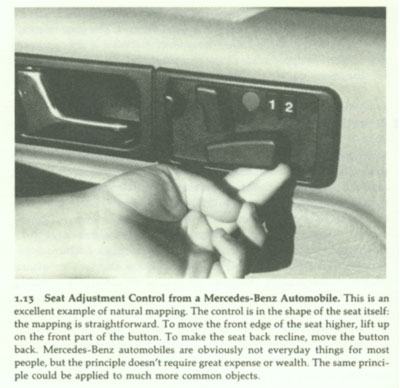
The shape/texture of the buttons needn't necessarily map to their function, as the seat adjustment control in a Mercedes-Benz (pictured to the right) does; simply making them easily distinguishable to the touch and laying them out in a reasonable (perhaps naturally-mapped) configuration would do the trick. It's easy to remember that the square button does this, the circular button, does that, etc. Far easier, then remembering that the top-middle button, which feels like all the other buttons, does something.
Sources of images: Button image from here. Seat-adjustment image from Norman, The Design of Everyday Things (2002)
Promoting Corporate Success vs. Promoting Consumer Choice
There are two ways to promote deregulation/privatization/marketization, which I'll refer to in this post simply as DPM. The first is to focus on the benefits to the economy, specifically the benefits that would come to "business." For example, someone might suggest that DPM will "be good for business," which to the average person that isn't already convince of the benefits of DPM sound like "allow big corporations that take advantage of the 'little guys' to make more money."
Of course, this couldn't be further from the truth, but that doesn't matter. The only thing that matters is the public's perception. It's frustrating, but it's true.
So what's the other way to promote DPM? By focusing on the increased choice ("consumer choice" is the most favorable way to phrase it) that will result from instituting DPM or, even better, never even enacting regulations in the first place. Tim Lee has done a great job of doing this in this op-ed, which argues against enacting legislation that would attempt to preserve "net neutrality."
Tim's op-ed sounds very positive to me. Even though he's arguing against the populist position (which says that we need net neutrality to maintain equal access to the internet), his argument comes off to me as slightly populist (i.e. it has popular appeal).
To sum up:
Of course, this couldn't be further from the truth, but that doesn't matter. The only thing that matters is the public's perception. It's frustrating, but it's true.
So what's the other way to promote DPM? By focusing on the increased choice ("consumer choice" is the most favorable way to phrase it) that will result from instituting DPM or, even better, never even enacting regulations in the first place. Tim Lee has done a great job of doing this in this op-ed, which argues against enacting legislation that would attempt to preserve "net neutrality."
Tim's op-ed sounds very positive to me. Even though he's arguing against the populist position (which says that we need net neutrality to maintain equal access to the internet), his argument comes off to me as slightly populist (i.e. it has popular appeal).
To sum up:
- more profits = bad public perception
- more consumer choice = good public perception
Deregulation vs. Privatiziation vs. Marketization
In general, libertarians (and some conservatives) favor reducing regulations. A term that was once popular but that now seems to carry negative connotations is "deregulation." For many, this term essentially means selling out to big corporate interests, usually at the expense of the public.
Whether such a perception is right or wrong is irrelevant--if people think that deregulation is bad, then it is bad.
An even nastier term than dergulation is "privatization." This term reeks of the corrupt sale of big Soviet industries to seedy businessmean and profiteers.
A better term (for now, at least) is marketization, which sounds better when it's used as a verb: "Energy rates would decrease if we were to marketize the power distribution system."
This term has two things going for it: (1) it hasn't been used a lot (at least recently) and (2) its root word is generally more positive and more accurately characterizes the goal of the concept.
"Deregulation" is inherently a negative word (with the prefix "de"), and simply "deregulating" something doesn't address what will happen to that something after it is no longer regulated.
"Privatiziation's" root word is "private," which connotes selfishness. Again, what will happen to something once it is "privatized?" Will those who had access to it in the past continue to have access to it in the future?
"Marketization's" root word, however, is "market." "Market" is the term that pretentious people use for "stores," as in, "I'm going to pick some celery up at the market." Plus, if something is "marketized," we know what the outcome will be. It will be transformed from its non-market state to a market state. That's all. Nothing to worry about.
But for me the post positive thing about "marketization" is that its root word implies consumer choice. What kind of "market" has only one option?
I'm sure there are technical differences between the three terms discussed above, but that doesn't really matter to me because I'm not an economist. And it doesn't really matter to a majority of Americans (who also aren't economists), because all that's important for them (and especially for the people trying to reach them!) is what they perceive.
Whether such a perception is right or wrong is irrelevant--if people think that deregulation is bad, then it is bad.
An even nastier term than dergulation is "privatization." This term reeks of the corrupt sale of big Soviet industries to seedy businessmean and profiteers.
A better term (for now, at least) is marketization, which sounds better when it's used as a verb: "Energy rates would decrease if we were to marketize the power distribution system."
This term has two things going for it: (1) it hasn't been used a lot (at least recently) and (2) its root word is generally more positive and more accurately characterizes the goal of the concept.
"Deregulation" is inherently a negative word (with the prefix "de"), and simply "deregulating" something doesn't address what will happen to that something after it is no longer regulated.
"Privatiziation's" root word is "private," which connotes selfishness. Again, what will happen to something once it is "privatized?" Will those who had access to it in the past continue to have access to it in the future?
"Marketization's" root word, however, is "market." "Market" is the term that pretentious people use for "stores," as in, "I'm going to pick some celery up at the market." Plus, if something is "marketized," we know what the outcome will be. It will be transformed from its non-market state to a market state. That's all. Nothing to worry about.
But for me the post positive thing about "marketization" is that its root word implies consumer choice. What kind of "market" has only one option?
I'm sure there are technical differences between the three terms discussed above, but that doesn't really matter to me because I'm not an economist. And it doesn't really matter to a majority of Americans (who also aren't economists), because all that's important for them (and especially for the people trying to reach them!) is what they perceive.
Sunday, July 9, 2006
Libertarians run some of the hottest "green" companies
 Two well know libertarians, T.J. Rodgers and John Mackey, who participated in a famous debate about the social responsibility of businees with none other than Milton Friedman, run two of the hottest "green" companies--SunPower Corporation and Whole Foods, respectively. SunPower Corporation is a member of the Wired 40, where it is lauded for its "photovoltaic silicon [that] puts out 50 percent more juice per square inch." Whole Foods, of course, is the most successful chain of supermarkets offering "natural and organic"food.
Sunday, June 25, 2006
Subscribe to:
Posts (Atom)