For one thing, I'm one of those crazy (small l) libertarians who thinks drug laws, on the whole, hurt society more than they help society, so I don't like this law. It's a shame that some people ruin their lives and their families' lives by using meth and other drugs, but the innocent people killed by muggers who need money to buy expensive drugs, the enrichment of street gangs and organized crime rings that sell illegal drugs, the corruption of government officials who take bribes from smugglers, the people who are falsely arrested on trumped up drug charges, the people who are killed by crazed bounty hunters and police raiding the wrong houses, the seizure of property belonging to people who didn't know there were drugs on their property, and the imprisonment of non-violent drug users amount to a bigger problem, I think. I am in favor of abolishing all drug laws.Well said.

Saturday, November 18, 2006
Nice rant
Mark Frauenfelder, the "small l libertarian" contributor to Boing Boing, has a nice rant about the incidental War on Allergy Sufferers, an unlikely child of the War on Terrorism and the War on Drugs:


Sunday, October 15, 2006
New Market for the Liberty Dollar?
I thought of something the other day. How might the recent ban on financial transactions for internet gambling affect using Liberty Dollars to pay for such services? After all, if the Liberty Dollar is not legal tender (PDF), can it really be covered under a ban on financial transactions? Isn't it just a fancy form of bartering?
Imagine...Liberty Dollars becoming the de facto standard currency for a fun activity that adults choose to participate in but that busybody politicians seek to prohibit...It's a perfect match!
UPDATE: For comments, see the original blog post here.
Imagine...Liberty Dollars becoming the de facto standard currency for a fun activity that adults choose to participate in but that busybody politicians seek to prohibit...It's a perfect match!
UPDATE: For comments, see the original blog post here.
Update
In case anyone has looked at this blog in the past couple months, I'd like to provide three reasons excuses for the dearth of posts:
1.) I got married in July, and that took up a lot of time
2.) I got a puppy in August, and that took up a lot of time
3.) I got a new car in September, and that took up a lot of time
Es tut mir leid.
1.) I got married in July, and that took up a lot of time
2.) I got a puppy in August, and that took up a lot of time
3.) I got a new car in September, and that took up a lot of time
Es tut mir leid.
Friday, August 11, 2006
The usability of buttons
 There's a new bad design up at baddesigns.com. In this case, Mike criticizes the use of poor icons on buttons used to control something (I still can't figure it out) in a car.
Indeed, the icons are useless. But I think another criticism of the buttons could be made. Any buttons placed within reach of the driver should require minimal visual attention, as the driver should be paying maximum attention to the task of driving (a task that is of course, highly visual). So not only should the buttons not be marked with confusing icons, they also shouldn't all be shaped and/or textured the same way.
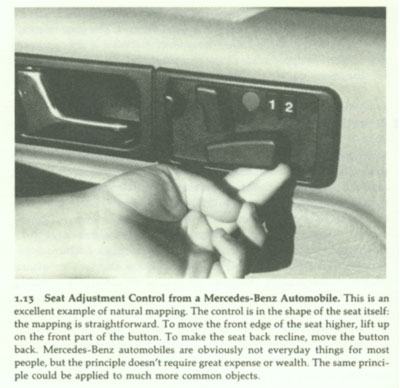
The shape/texture of the buttons needn't necessarily map to their function, as the seat adjustment control in a Mercedes-Benz (pictured to the right) does; simply making them easily distinguishable to the touch and laying them out in a reasonable (perhaps naturally-mapped) configuration would do the trick. It's easy to remember that the square button does this, the circular button, does that, etc. Far easier, then remembering that the top-middle button, which feels like all the other buttons, does something.
Sources of images: Button image from here. Seat-adjustment image from Norman, The Design of Everyday Things (2002)
Promoting Corporate Success vs. Promoting Consumer Choice
There are two ways to promote deregulation/privatization/marketization, which I'll refer to in this post simply as DPM. The first is to focus on the benefits to the economy, specifically the benefits that would come to "business." For example, someone might suggest that DPM will "be good for business," which to the average person that isn't already convince of the benefits of DPM sound like "allow big corporations that take advantage of the 'little guys' to make more money."
Of course, this couldn't be further from the truth, but that doesn't matter. The only thing that matters is the public's perception. It's frustrating, but it's true.
So what's the other way to promote DPM? By focusing on the increased choice ("consumer choice" is the most favorable way to phrase it) that will result from instituting DPM or, even better, never even enacting regulations in the first place. Tim Lee has done a great job of doing this in this op-ed, which argues against enacting legislation that would attempt to preserve "net neutrality."
Tim's op-ed sounds very positive to me. Even though he's arguing against the populist position (which says that we need net neutrality to maintain equal access to the internet), his argument comes off to me as slightly populist (i.e. it has popular appeal).
To sum up:
Of course, this couldn't be further from the truth, but that doesn't matter. The only thing that matters is the public's perception. It's frustrating, but it's true.
So what's the other way to promote DPM? By focusing on the increased choice ("consumer choice" is the most favorable way to phrase it) that will result from instituting DPM or, even better, never even enacting regulations in the first place. Tim Lee has done a great job of doing this in this op-ed, which argues against enacting legislation that would attempt to preserve "net neutrality."
Tim's op-ed sounds very positive to me. Even though he's arguing against the populist position (which says that we need net neutrality to maintain equal access to the internet), his argument comes off to me as slightly populist (i.e. it has popular appeal).
To sum up:
- more profits = bad public perception
- more consumer choice = good public perception
Deregulation vs. Privatiziation vs. Marketization
In general, libertarians (and some conservatives) favor reducing regulations. A term that was once popular but that now seems to carry negative connotations is "deregulation." For many, this term essentially means selling out to big corporate interests, usually at the expense of the public.
Whether such a perception is right or wrong is irrelevant--if people think that deregulation is bad, then it is bad.
An even nastier term than dergulation is "privatization." This term reeks of the corrupt sale of big Soviet industries to seedy businessmean and profiteers.
A better term (for now, at least) is marketization, which sounds better when it's used as a verb: "Energy rates would decrease if we were to marketize the power distribution system."
This term has two things going for it: (1) it hasn't been used a lot (at least recently) and (2) its root word is generally more positive and more accurately characterizes the goal of the concept.
"Deregulation" is inherently a negative word (with the prefix "de"), and simply "deregulating" something doesn't address what will happen to that something after it is no longer regulated.
"Privatiziation's" root word is "private," which connotes selfishness. Again, what will happen to something once it is "privatized?" Will those who had access to it in the past continue to have access to it in the future?
"Marketization's" root word, however, is "market." "Market" is the term that pretentious people use for "stores," as in, "I'm going to pick some celery up at the market." Plus, if something is "marketized," we know what the outcome will be. It will be transformed from its non-market state to a market state. That's all. Nothing to worry about.
But for me the post positive thing about "marketization" is that its root word implies consumer choice. What kind of "market" has only one option?
I'm sure there are technical differences between the three terms discussed above, but that doesn't really matter to me because I'm not an economist. And it doesn't really matter to a majority of Americans (who also aren't economists), because all that's important for them (and especially for the people trying to reach them!) is what they perceive.
Whether such a perception is right or wrong is irrelevant--if people think that deregulation is bad, then it is bad.
An even nastier term than dergulation is "privatization." This term reeks of the corrupt sale of big Soviet industries to seedy businessmean and profiteers.
A better term (for now, at least) is marketization, which sounds better when it's used as a verb: "Energy rates would decrease if we were to marketize the power distribution system."
This term has two things going for it: (1) it hasn't been used a lot (at least recently) and (2) its root word is generally more positive and more accurately characterizes the goal of the concept.
"Deregulation" is inherently a negative word (with the prefix "de"), and simply "deregulating" something doesn't address what will happen to that something after it is no longer regulated.
"Privatiziation's" root word is "private," which connotes selfishness. Again, what will happen to something once it is "privatized?" Will those who had access to it in the past continue to have access to it in the future?
"Marketization's" root word, however, is "market." "Market" is the term that pretentious people use for "stores," as in, "I'm going to pick some celery up at the market." Plus, if something is "marketized," we know what the outcome will be. It will be transformed from its non-market state to a market state. That's all. Nothing to worry about.
But for me the post positive thing about "marketization" is that its root word implies consumer choice. What kind of "market" has only one option?
I'm sure there are technical differences between the three terms discussed above, but that doesn't really matter to me because I'm not an economist. And it doesn't really matter to a majority of Americans (who also aren't economists), because all that's important for them (and especially for the people trying to reach them!) is what they perceive.
Sunday, July 9, 2006
Libertarians run some of the hottest "green" companies
 Two well know libertarians, T.J. Rodgers and John Mackey, who participated in a famous debate about the social responsibility of businees with none other than Milton Friedman, run two of the hottest "green" companies--SunPower Corporation and Whole Foods, respectively. SunPower Corporation is a member of the Wired 40, where it is lauded for its "photovoltaic silicon [that] puts out 50 percent more juice per square inch." Whole Foods, of course, is the most successful chain of supermarkets offering "natural and organic"food.
Sunday, June 25, 2006
Saturday, June 17, 2006
Popular Science summary of new enegery technologies

This Popular Science site has some great summaries of future "alternative" energy ideas.
I found out about this site from this post.
Saturday, June 3, 2006
Another reason to abolish the FDA
From here:
Such government intrusion into our media and our spirituality would be almost universally seen as wrong.
Why should it be any different with a government agency like the FDA? While the FDA and the healthists wear a public face of "serving the public good," it now seems like they're intentionally trying to usurp responsibility from individuals.
I don't want to be "encouraged" to eat more or less of anything, and I certainly don't want restaurants to be "urged" to serve smaller portions and more fruits and vegetables. 1.) Restaurants already serve a lot of fruits and vegetables...they're called salads! Almost every restaurant (including the Great Satan McDonald's) sells them. 2.) If you want a smaller portion, eat half of what you order and take the other half home.
The report, requested and funded by the Food and Drug Administration, lays out ways to help people manage their intake of calories from the growing number of meals prepared away from home, including at the nation's nearly 900,000 restaurants and other establishments that serve food.What if a government agency "encouraged" media companies to show more "good news" and human interest stories, because, gee whiz, that stuff makes people feel better? What if a government agency recommended that atheists take a fresh look at Christianity, because Christians tend to be happier?
...
The report encourages restaurants to shift the emphasis of their marketing to lower-calorie choices, and include more such options on menus. In addition, restaurants could jigger portion sizes and the variety of foods available in mixed dishes to reduce the overall number of calories taken in by diners.
Such government intrusion into our media and our spirituality would be almost universally seen as wrong.
Why should it be any different with a government agency like the FDA? While the FDA and the healthists wear a public face of "serving the public good," it now seems like they're intentionally trying to usurp responsibility from individuals.
I don't want to be "encouraged" to eat more or less of anything, and I certainly don't want restaurants to be "urged" to serve smaller portions and more fruits and vegetables. 1.) Restaurants already serve a lot of fruits and vegetables...they're called salads! Almost every restaurant (including the Great Satan McDonald's) sells them. 2.) If you want a smaller portion, eat half of what you order and take the other half home.
Subscribe to:
Comments (Atom)