Wednesday, July 23, 2008

Wal-Mart Leads to Destruction!!


Creative destruction, that is. In other words, the good kind of destruction. Out with the old and inefficient and in with the new and exciting. This post by Mark Perry summarizes a Cato Institute study [PDF] concluding that, if anything, Wal-Mart has a net positive effect on the number of small businesses in a community.

Myth: Mega discount store Wal-Mart is a plague set upon small “mom-and-pop” businesses. The instant Wal-Mart moves into town, all small businesses are destroyed in its path, leaving downtowns barren and empty. According to Robert Reich, Wal-Mart turns “main streets into ghost towns by sucking business away from small retailers.”

Reality: The popular belief that Wal-Mart has a significant negative effect on the size of the mom-and-pop business sector of the United States economy is statistically unfounded. After examining a plethora of different measures of small business activity and growth, examining both time series and cross-section data, and employing different geographic levels of data and different econometric techniques, it can be firmly concluded that Wal-Mart has had no significant impact on the overall size and growth of U.S. small business activity.

The key is in recognizing that the world is dynamic. Sure, Wal-Mart will crush small businesses with which it directly competes. But, as the study states:

The previous research on Wal-Mart's effects did not correctly model the welfare-enhancing process of "creative destruction." Creative destruction occurs when the introduction of a new idea or product results in the obsolescence of other products. New inventions, for instance, often result in the business failures of products supplanted by now-outdated technologies. That is unfortunate for the old businesses, but it benefits consumers and it frees money and resources that can then give rise to new businesses and further advancements.

For instance, the locale of our university, Morgantown, W.Va., just one of many cities that have witnessed, first-hand, the process of creative destruction unleashed by Wal-Mart. Shortly after a new Wal-Mart store opened, Morgantown's popular downtown area was wrought with empty storefronts. However, after only a brief period of time, the once-empty storefronts filled with new small businesses. A former women's clothing shop transformed into a high-end restaurant. A former electronics store converted into an ice cream parlor. One by one, each of the vacant stores filled with new businesses, such as coffee shops, art galleries, and law firms.

The study concludes:

There is no question that Wal-Mart does cause some mom-and-pop businesses to fail. However, those failures are entirely compensated for by the entry of other new small business elsewhere in the economy through the process of creative destruction.

I hope this study gets the attention and respect it deserves, but the fact that it's coming from the Cato Institute, which has been libeled as "neoconservative" by the popular author Naomi Klein, will probably imply a bias that I don't believe is there. But hopefully the study will serve as a resource for future studies by more impartial institutions that will reach the same conclusion.

Image from Flickr user James Moore available under a Creative Commons license

Tuesday, July 22, 2008

Human Brains Don't Function As Well When Fatigued

An interesting article at Scientific American summarizes an interesting area of psychology/decision making research and its intriguing conclusions:

For instance, it's long been recognized that strenuous cognitive tasks—such as taking the SAT—can make it harder to focus later on. But recent results suggests that these taxing mental activities may be much broader in scope-and may even involve the very common activity of making choices itself. In a series of experiments and field studies, University of Minnesota psychologist Kathleen Vohs and colleagues repeatedly demonstrate that the mere act of making a selection may deplete executive resources. For example, in one study the researchers found that participants who made more choices in a mall were less likely to persist and do well in solving simple algebra problems.

...

In a parallel investigation, Yale University professor Nathan Novemsky and his colleagues suggest that the mere act of resolving tradeoffs may be depleting. For example, in one study, the scientists show that people who had to rate the attractiveness of different options were much less depleted than those who had to actually make choices between the very same options.

I'm still trying to think through how this research can be applied to human factors/user interface design, but to me it suggests that user interface designers should consider not only the dynamic cognitive load a user experiences at any given point while operating some product or system, but also the cumulative cognitive load. In other words, if you burden users with having to make a bunch of choices (even if the choices themselves are not all that taxing) that require frequent shifts in attention, you shouldn't expect those users to be able to perform at peak cognitive levels while busy with one task (obviously) or even after a busy task has just been completed (not so obvious).

Some questions:
  1. How long does it take for a person's cognitive capacity to "recharge?"
  2. Also, can one build up "cognitive endurance" through training?
  3. Is this why people become frustrated at a seemingly exponential rate when, after repeated attempts, something STILL doesn't work?

Image from Flickr user bootload
available under a Creative Commons license

A New Hope!

Kottke points to inappropriate movie soundtracks, among them a scene from Star Wars Episode IV, A New Hope, set to Queen and David Bowie's Under Pressure. Here's the video:


The YouTube name for the video is "A New Hope ruined scene," but I actually love it! Maybe it's the fact that I'm so familiar with the characters or maybe it's just like Pink Floyd and the Wizard of Oz, but I actually feel more emotions watching that video than simply listening to the song (which I love!). I only wish the video wouldn't cut out when it does. Just as the song is reaching its celebratory climax, Luke et al. are saved by C3PO and R2D2 and begin celebrating. But the video tragically stops. Oh well, it's still fun to watch.

Sunday, July 20, 2008

Non-organic Food

I'm pretty sure this is a completely non-organic meal:


Via this post by Andrew Sullivan guestblogger Chris Bodenner.

Do Regulations Make Cities Un-livable?


Matt Yglesias has been making some really good points recently about how local government regulations and ordinances can often lead to less-livable cities.

On July 20, he discussed liquor licensing and zoning:

And movie theaters aside DC would, in general, have more bars that feature nice outdoor areas (a) easier to get a license to open a bar, and (b) easier to get a license to establish outdoor tables.

A relatively strict licensing regime keeps the number of drinking establishments relatively low. That reduces one's set of options. But beyond that, it makes for a less competitive environment with higher prices and less effort going into making an establishment appealing. Laxer licensing regimes and more liberal zoning policies about where you can open retail would produce lower prices and more options.

On July 19, he talked about affordable housing:

To me one of the oddest aspects of endless discussions about affordable housing is how little emphasis there is on the fact that many areas have straightforward rules in place that just make it illegal for housing to be affordable. For example, in Arlington County Virginia you might own a nice big house. And maybe you're an empty nester who doesn't need as much space in the home anymore now that the kids are out of the house. So maybe you want to modify the structure somewhat to create a so-called "accessory dwelling" in the garage or the basement that you can rent out to people looking for a cheap place to live.

Well, you can't. It's illegal.

And back in April he covered government-subsidized/mandated parking here:

But that's what you should have -- as much parking as the market will bear. Not government-mandated parking, and not government-provided free or discount parking. Let people build garages and if it's more economical to provide less parking, let there be less parking.

and here:

When you mandate vast acres of un-priced or underpriced parking, that leads to lots of driving. But the space used up by all that parking is still a real resource -- nothing comes "for free." When you don't make those mandates, the world doesn't end and people don't just spend eternity driving in circles looking for spaces. Instead, a combination of market-priced parking and alternatives to driving can meet people's needs.

Yglesias is regarded as a modern (as opposed to classical) liberal, but I think he's much more libertarian than he gets credit for.

Image is Camille Pissarro's Boulevard Montmartre, morning, cloudy weather, 1897, from here.

Saturday, July 19, 2008

Usable Lab Tools


I had to use a thumb-actuated pipette like the one pictured above (left) a little bit (less than 2 hours total) in college. I don't remember it being particularly annoying, but I do remember it not working all that well. The Ergopip (right) looks much more comfortable to use and is actuated by a user's fingers.

This makes me wonder if the entire chemistry lab experience could be made easier and more accessible if lab tools (such as titration tubes, graduated cylinders, Bunsen burners, etc.) were easier to use. Not just physically (i.e. ergonomically), but also cognitively. In high school and in college, I remember almost always having a tricky time using the equipment, which inevitably slowed my progress down, which in turn made me frustrated that my classmates were moving through the lab exercise while I struggled to get the equipment set up. Maybe I would have (1) enjoyed chemistry more and (2) learned more about chemistry if I could have actually appreciated the technical content of lab exercises instead of trying to become a master at shutting off the titration valve at just the right time.

Ergopip information via Medgadget.

Image on left from here, image on right from here.

Wednesday, July 16, 2008

My Tires Are Bad, Too


Rogier Van Biekel says the tires on his fairly new vehicle are bad:
Which is as good a time as any to report that the tires on my 18-month-old Toyota RAV4 Limited are as bald as the eagle who nests in the trees across my house. The car (and the tires) have just 30,000 miles on them. I'd never heard of modern tires that (properly inflated and rotated) last fewer than 30,000 miles. All the tires I've bought in my dozen years of car ownership have, in fact, had warranties in the 50-60,000-mile ballpark.

The tires on my 2007 Mazda 3 (with just under 36,000 miles) are also in need of replacement. It'll be nice to have new tires (my car's handling has decreased dramatically but I'm guessing I've adjusted and forgotten how good it once was), but I'm not looking forward to spending $500-600.

The user experience of public transportation seems much more fixed and predictable than the user experience of driving/owning a car. Once you figure out your route on public transportation, travel times (especially on non-bus options) and costs are pretty fixed. But with a car, just when you think your car is good to go, some unexpected problem inevitably shows up. I used to think the IRS rate (currently around $0.50 per mile) of owning a car was higher than what it should be, but the longer I've owned cars the less I've thought this.

All this just reinforces my desire to live somewhere where I can commute via some combination of walking, biking, riding a subway/light rail/bus. I like driving, but I could live with only driving a couple times a week. Driving 35 miles to work each way every day is too much.

Image from Flickr user dmitriyo available under a Creative Commons license

Tuesday, July 15, 2008

You don't have to subsidize it just because it's green

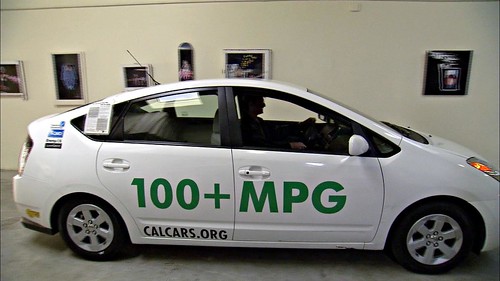
While listening to NPR/MPR (I never know which one owns whatever show I'm listening to at any given moment, but it was on 91.1), I learned that Minneapolis was one of six cities selected (by Hymotion, I assume) to have a local Hymotion installation partner. Apparently, Minneapolis was selected after Mayor R.T. Rybak lobbied for Minneapolis:
Originally, they wouldn’t have been able to. Minneapolis was not on the list of six cities selected to be test sites for the technology. But when Rybak caught wind of this, he said he stepped in and told the manufacturer that he may be the only mayor in the country who drives a plug-in hybrid, that it therefore made sense for the technology to come here.

Based on this paragraph, the narrative features a green company (Hymotion) responding sensibly to a request by a plug-in hybrid-driving mayor to market their new technology in the city over which he presides. Everybody gets along, and everybody's happy. Even the "evil corporation" comes off looking good.

But further down in the article I saw this:
The operations aren’t cheap, costing about $10,000. But the state is offering help in the form of a grant program meant to expand the use of plug-in technology. It’s expected to lower the cost by about a third, state Rep. Frank Hornstein (DFL-60B) said.

“This is really the cheapest and environmentally best response to high gas prices,” Hornstein said.

Ahhh...might one of the reasons that oh-so-benevolent Hymotion chose Minneapolis as one of its first six cities be the generous subsidy codified by Rep. Hornstein? The plot thickens...

In any case, it appears that "orders [at the Minneapolis dealer] are booked full through December" (according to Hymotion customer service representative Jim Strong). Is this because a bunch of well-informed hybrid owners are banking on the $3,000 subsidy, or would interest be just as strong without the subsidy? Alas, we'll never know, but from Hymotion's perspective a subsidy certainly won't hurt demand.

My guess is that removing the subsidy wouldn't decrease interest substantially. If you can afford $7,000 to modify what is likely a fairly new car, you can afford $10,000 to do the same. So the subsidy seems essentially like a $3,000 gift to people who already own hybrid cars...in other words, upper and upper-middle class people who don't need it.

One final twist to this fun story: Rep. Hornstein owns a hybrid car [PDF] (search for "hybrid"), which apparently he auctions off the use of.


It looks like the Hornsteins owns a Honda Civic Hybrid; although Hymotion currently only makes kits for 2004-2008 Priuses, it wouldn't surprise me if the next model Hymotion goes after is the Honda Civic Hybrid.

Image from Flickr user kqedquest available under a Creative Cmmons license

Monday, July 14, 2008

Roundabouts, please!

Via this post, I discovered the following video, which basically proves via simulation that roundabouts are far superior to intersections with stoplights. Shown to the right is a bird's eye view of the intersection of Valley View Road (Hwy. 212) and Prairie Center Drive in Eden Prairie, MN. This suburban mega-intersection is the bane of my existence on Tuesday mornings when I have to bring my dog Milo to doggy daycare at Petsmart. Each direction has two left turn lanes, so as soon as the cross-traffic has all red lights, you can't go straight until the left turn lights have run their course...as the picture shows, since the intersection is in hyper-safe Minnesota (which seems to have very long "all red" times in which no traffic moves through the intersection), most of the time the intersection is sparsely filled with cars. If that's not inefficient, I don't know what is. As the video below shows, roundabouts are far more efficient.

Plus roundabouts are fun.

Sunday, July 13, 2008

Everything's Dynamic

The world is dynamic...all of it. So my clever blog name has multiple interpretations:

Everything's dynamic - Everything is dynamic
Everything's dynamic - The dynamic of everything
(Unofficial third meaning): Everythings dynamic - All things dynamic (not grammatically correct, but so what...)

Unlike Garth, I don't fear change. Well, I do, but not officially.